 Add to Chrome
 Add to Firefox
 Add to Edge
VisualNeedle: Benchmarking Active Visual Search in Information-Dense Scenes
May 25, 2026
Frontier multimodal large language models (MLLMs) have been reported to achieve over 90% accuracy on fine-grained perception benchmarks. However, such scores do not necessarily imply faithful use of visual evidence. Prior studies have identified three shortcuts that inflate benchmark performance. First, linguistic priors and lexical cues in questions often enable models to infer plausible answers without seeing the image. Second, coarse global semantics from the visual encoder can bypass fine-grained local details. Third, in some ``think-with-images'' benchmarks, corrupting the intermediate images returned by visual tools barely affects the final answer. These findings suggest that higher input resolution or larger question pools alone do not elicit genuine active visual search. To address this, we introduce VisualNeedle, a challenging, information-dense, and fine-grained benchmark for scenes where critical evidence is spatially constrained to minute regions and not discernible at a glance. We further propose a counterfactual crop-black setting, which replaces crops returned by tools with black images of the same size, to test whether tool-enabled performance truly relies on intermediate visual evidence. We evaluate 9 promninent MLLMs across three settings: no-tool, standard tool-enabled, and crop-black. No-tool accuracy stays below 20\%, and the best tool-enabled model reaches only 56.01\%, still trailing the 63.00% human majority-vote accuracy. These results reveal persistent limitations in fine-grained visual search, while the crop-black ablation confirms that success on VisualNeedle hinges on genuine intermediate visual evidence.

Distinguishing Right from Wrong in Debates: Attribution Analysis of Chinese Harmful Memes
May 23, 2026Research on harmful meme detection has garnered significant attention, resulting in the development of numerous datasets and methods. However, progress in detecting Chinese harmful memes lags considerably, primarily due to two challenges: first, accurately assessing a meme's harmfulness depends heavily on understanding deep cultural context; second, many memes are semantically ambiguous, making harmfulness highly subjective. To address these issues, we focus on the interpretable detection of Chinese harmful memes by constructing the first Chinese harmful meme explanation dataset, Ex-ToxiCN-MM. This dataset offers opposing interpretations, categorized as "harmful" and "non-harmful", for each meme, aiming to rigorously evaluate a model's ability to discern and comprehend ambiguous, culturally grounded content. We built a specialized knowledge base of Chinese cultural concepts and offensive vocabulary to supply models with essential prior knowledge (C-HarmKB). To address the ambiguity and lack of background knowledge in meme attribution, we have developed a comprehensive attribution analysis framework, RIKE, which includes an Attribution Knowledge Enhancement module (AKE) and a Relative Intent Reasoning module (RIR). Extensive quantitative and qualitative experiments demonstrate that our method outperforms mainstream baseline models across multiple metrics in the task of attributing harmful memes in Chinese. The code, Ex-ToxiCN-MM dataset, and Chinese Harmful Semantic Knowledge Base (C-HarmKB) involved in this study have been open-sourced at https://github.com/wimiw123/Ex-ToxiCN-MM
Aligning LLM Uncertainty with Human Disagreement in Subjectivity Analysis
May 11, 2026Large language models for subjectivity analysis are typically trained with aggregated labels, which compress variations in human judgment into a single supervision signal. This paradigm overlooks the intrinsic uncertainty of low-agreement samples and often induces overconfident predictions, undermining reliability and generalization in complex subjective settings. In this work, we advocate uncertainty-aware subjectivity analysis, where models are expected to make predictions while expressing uncertainty that reflects human disagreement. To operationalize this perspective, we propose a two-phase Disagreement Perception and Uncertainty Alignment (DPUA) framework. Specifically, DPUA jointly models label prediction, rationale generation, and uncertainty expression under an uncertainty-aware setting. In the disagreement perception phase, adaptive decoupled learning enhances the model's sensitivity to disagreement-related cues while preserving task performance. In the uncertainty alignment phase, GRPO-based reward optimization further improves uncertainty-aware reasoning and aligns the model's confidence expression with the human disagreement distribution. Experiments on three subjectivity analysis tasks show that DPUA preserves task performance while better aligning model uncertainty with human disagreement, mitigating overconfidence on boundary samples, and improving out-of-distribution generalization.
From Pixels to Nucleotides: End-to-End Token-Based Video Compression for DNA Storage
Apr 15, 2026DNA-based storage has emerged as a promising approach to the global data crisis, offering molecular-scale density and millennial-scale stability at low maintenance cost. Over the past decade, substantial progress has been made in storing text, images, and files in DNA -- yet video remains an open challenge. The difficulty is not merely technical: effective video DNA storage requires co-designing compression and molecular encoding from the ground up, a challenge that sits at the intersection of two fields that have largely evolved independently. In this work, we present HELIX, the first end-to-end neural network jointly optimizing video compression and DNA encoding -- prior approaches treat the two stages independently, leaving biochemical constraints and compression objectives fundamentally misaligned. Our key insight: token-based representations naturally align with DNA's quaternary alphabet -- discrete semantic units map directly to ATCG bases. We introduce TK-SCONE (Token-Kronecker Structured Constraint-Optimized Neural Encoding), which achieves 1.91 bits per nucleotide through Kronecker-structured mixing that breaks spatial correlations and FSM-based mapping that guarantees biochemical constraints. Unlike two-stage approaches, HELIX learns token distributions simultaneously optimized for visual quality, prediction under masking, and DNA synthesis efficiency. This work demonstrates for the first time that learned compression and molecular storage converge naturally at token representations -- suggesting a new paradigm where neural video codecs are designed for biological substrates from the ground up.
Propagating Similarity, Mitigating Uncertainty: Similarity Propagation-enhanced Uncertainty for Multimodal Recommendation
Jan 27, 2026Multimodal Recommendation (MMR) systems are crucial for modern platforms but are often hampered by inherent noise and uncertainty in modal features, such as blurry images, diverse visual appearances, or ambiguous text. Existing methods often overlook this modality-specific uncertainty, leading to ineffective feature fusion. Furthermore, they fail to leverage rich similarity patterns among users and items to refine representations and their corresponding uncertainty estimates. To address these challenges, we propose a novel framework, Similarity Propagation-enhanced Uncertainty for Multimodal Recommendation (SPUMR). SPUMR explicitly models and mitigates uncertainty by first constructing the Modality Similarity Graph and the Collaborative Similarity Graph to refine representations from both content and behavioral perspectives. The Uncertainty-aware Preference Aggregation module then adaptively fuses the refined multimodal features, assigning greater weight to more reliable modalities. Extensive experiments on three benchmark datasets demonstrate that SPUMR achieves significant improvements over existing leading methods.
The Straight and Narrow: Do LLMs Possess an Internal Moral Path?
Jan 15, 2026Enhancing the moral alignment of Large Language Models (LLMs) is a critical challenge in AI safety. Current alignment techniques often act as superficial guardrails, leaving the intrinsic moral representations of LLMs largely untouched. In this paper, we bridge this gap by leveraging Moral Foundations Theory (MFT) to map and manipulate the fine-grained moral landscape of LLMs. Through cross-lingual linear probing, we validate the shared nature of moral representations in middle layers and uncover a shared yet different moral subspace between English and Chinese. Building upon this, we extract steerable Moral Vectors and successfully validate their efficacy at both internal and behavioral levels. Leveraging the high generalizability of morality, we propose Adaptive Moral Fusion (AMF), a dynamic inference-time intervention that synergizes probe detection with vector injection to tackle the safety-helpfulness trade-off. Empirical results confirm that our approach acts as a targeted intrinsic defense, effectively reducing incorrect refusals on benign queries while minimizing jailbreak success rates compared to standard baselines.
Sensing-enabled Secure Rotatable Array System Enhanced by Multi-Layer Transmitting RIS
Nov 17, 2025Programmable metasurfaces and adjustable antennas are promising technologies. The security of a rotatable array system is investigated in this paper. A dual-base-station (BS) architecture is adopted, in which the BSs collaboratively perform integrated sensing of the eavesdropper (the target) and communication tasks. To address the security challenge when the sensing target is located on the main communication link, the problem of maximizing the secrecy rate (SR) under sensing signal-to-interference-plus-noise ratio requirements and discrete constraints is formulated. This problem involves the joint optimization of the array pose, the antenna distribution on the array surface, the multi-layer transmitting RIS phase matrices, and the beamforming matrices, which is non-convex. To solve this challenge, an two-stage online algorithm based on the generalized Rayleigh quotient and an offline algorithm based on the Multi-Agent Deep Deterministic Policy Gradient are proposed. Simulation results validate the effectiveness of the proposed algorithms. Compared to conventional schemes without array pose adjustment, the proposed approach achieves approximately 22\% improvement in SR. Furthermore, array rotation provides higher performance gains than position changes.
FOUND: Fourier-based von Mises Distribution for Robust Single Domain Generalization in Object Detection
Nov 13, 2025Single Domain Generalization (SDG) for object detection aims to train a model on a single source domain that can generalize effectively to unseen target domains. While recent methods like CLIP-based semantic augmentation have shown promise, they often overlook the underlying structure of feature distributions and frequency-domain characteristics that are critical for robustness. In this paper, we propose a novel framework that enhances SDG object detection by integrating the von Mises-Fisher (vMF) distribution and Fourier transformation into a CLIP-guided pipeline. Specifically, we model the directional features of object representations using vMF to better capture domain-invariant semantic structures in the embedding space. Additionally, we introduce a Fourier-based augmentation strategy that perturbs amplitude and phase components to simulate domain shifts in the frequency domain, further improving feature robustness. Our method not only preserves the semantic alignment benefits of CLIP but also enriches feature diversity and structural consistency across domains. Extensive experiments on the diverse weather-driving benchmark demonstrate that our approach outperforms the existing state-of-the-art method.
Probing the Critical Point (CritPt) of AI Reasoning: a Frontier Physics Research Benchmark
Oct 01, 2025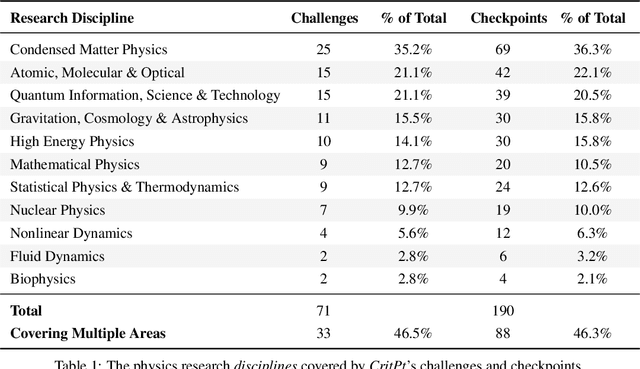
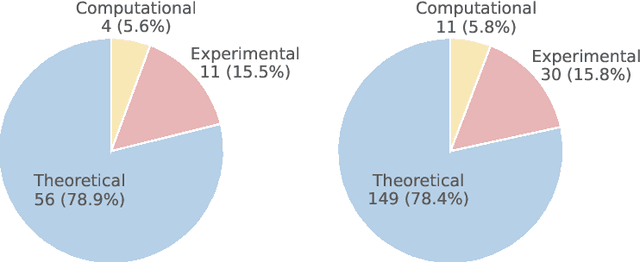
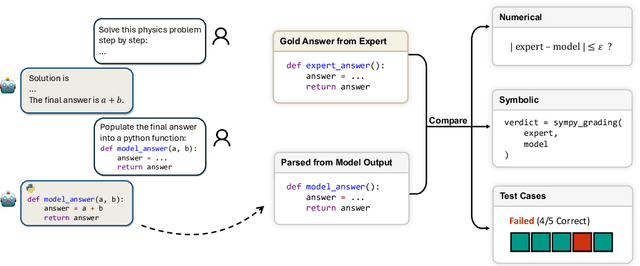
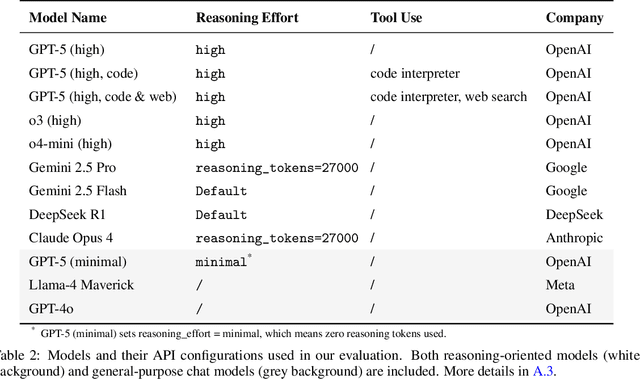
While large language models (LLMs) with reasoning capabilities are progressing rapidly on high-school math competitions and coding, can they reason effectively through complex, open-ended challenges found in frontier physics research? And crucially, what kinds of reasoning tasks do physicists want LLMs to assist with? To address these questions, we present the CritPt (Complex Research using Integrated Thinking - Physics Test, pronounced "critical point"), the first benchmark designed to test LLMs on unpublished, research-level reasoning tasks that broadly covers modern physics research areas, including condensed matter, quantum physics, atomic, molecular & optical physics, astrophysics, high energy physics, mathematical physics, statistical physics, nuclear physics, nonlinear dynamics, fluid dynamics and biophysics. CritPt consists of 71 composite research challenges designed to simulate full-scale research projects at the entry level, which are also decomposed to 190 simpler checkpoint tasks for more fine-grained insights. All problems are newly created by 50+ active physics researchers based on their own research. Every problem is hand-curated to admit a guess-resistant and machine-verifiable answer and is evaluated by an automated grading pipeline heavily customized for advanced physics-specific output formats. We find that while current state-of-the-art LLMs show early promise on isolated checkpoints, they remain far from being able to reliably solve full research-scale challenges: the best average accuracy among base models is only 4.0% , achieved by GPT-5 (high), moderately rising to around 10% when equipped with coding tools. Through the realistic yet standardized evaluation offered by CritPt, we highlight a large disconnect between current model capabilities and realistic physics research demands, offering a foundation to guide the development of scientifically grounded AI tools.
Rethinking Contrastive Learning in Session-based Recommendation
Jun 05, 2025
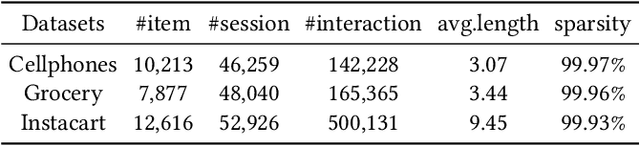
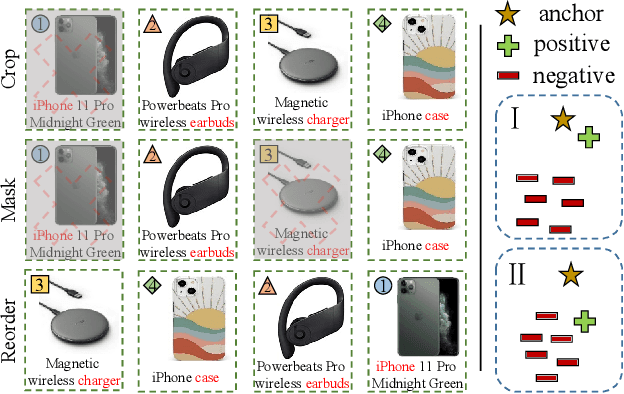
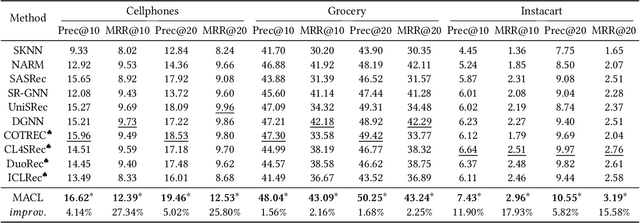
Session-based recommendation aims to predict intents of anonymous users based on limited behaviors. With the ability in alleviating data sparsity, contrastive learning is prevailing in the task. However, we spot that existing contrastive learning based methods still suffer from three obstacles: (1) they overlook item-level sparsity and primarily focus on session-level sparsity; (2) they typically augment sessions using item IDs like crop, mask and reorder, failing to ensure the semantic consistency of augmented views; (3) they treat all positive-negative signals equally, without considering their varying utility. To this end, we propose a novel multi-modal adaptive contrastive learning framework called MACL for session-based recommendation. In MACL, a multi-modal augmentation is devised to generate semantically consistent views at both item and session levels by leveraging item multi-modal features. Besides, we present an adaptive contrastive loss that distinguishes varying contributions of positive-negative signals to improve self-supervised learning. Extensive experiments on three real-world datasets demonstrate the superiority of MACL over state-of-the-art methods.